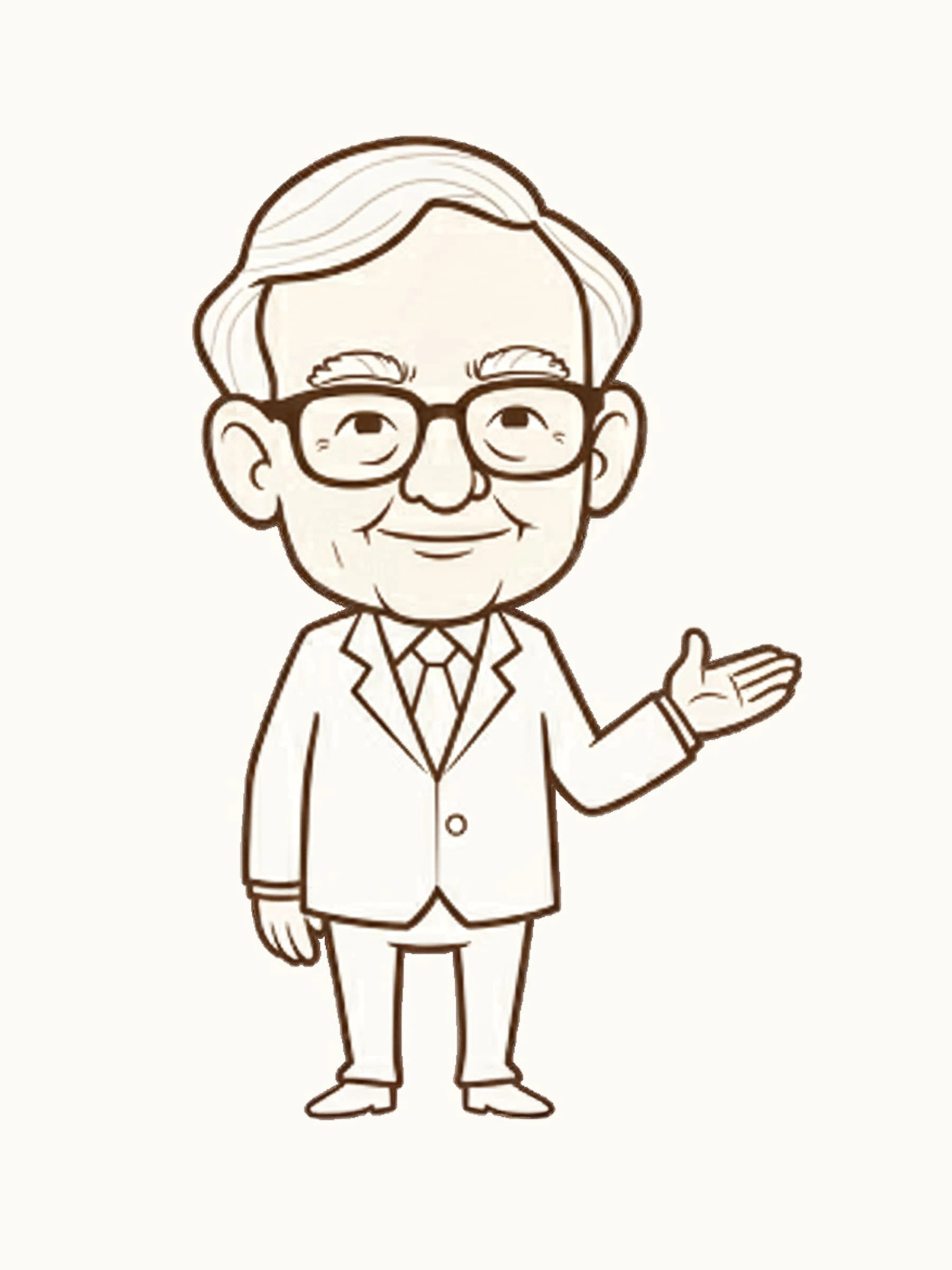
Warren Buffett is a legendary figure in the world of value investing and is a permanent fixture on the Forbes billionaires list. He basically kicked off a new era for investors. Most of what we know about modern value investing today is built on the core concepts and theories he pioneered. Even if you have never touched a stock in your life, you probably have a pretty good idea of who he is.
His story isn't just about piling up wealth; it is a complete investment philosophy. For many, it serves as the ultimate introduction to investing and business management. I'm definitely one of those people who learned the ropes from him.
Warren Buffett
Buffett is a legend in the investing world, a big-time philanthropist, and the long-time chairman and CEO of Berkshire Hathaway. People call him the "Oracle of Omaha" because of his incredible track record over the decades and the wisdom he shares in his annual shareholder letters.
He was once named the top money manager of the 20th century in a Carson Group survey, even beating out other heavy hitters like Peter Lynch and John Templeton. Time magazine also listed him as one of the world's 100 most influential people.
He lives and works in Omaha, Nebraska, staying far away from the hype and gambling of Wall Street. Being physically away from the noise has helped him stay independent, rational, and immune to market panic. The way his wealth has grown steadily over time is the best proof that his long-term value strategy actually works.
- 1930 Born: Born in Omaha, Nebraska.
- 1941 First stock investment: Bought his first stock at 11 years old, Cities Service Preferred.
- 1945 Early side hustles: As a teen, he made $175 a month delivering the Washington Post and invested $1,200 in a farm.
- 1950 College graduation: Graduated from the University of Nebraska.
- 1951 Learning from Benjamin Graham: Earned his master's in economics from Columbia Business School, studying under the "father of value investing," Benjamin Graham.
- 1954 Working for Graham: Joined Graham-Newman Corp. with a $12,000 salary.
- 1956 Launching his partnership: Moved back to Omaha and started Buffett Associates, Ltd. with money from family and friends.
- 1959 Meeting Charlie Munger: Met his lifelong partner, Charlie Munger, who later became the vice chairman of Berkshire.
- 1962 Starting the Berkshire Hathaway investment: Began buying shares in the struggling textile company, Berkshire Hathaway.
- 1965 Taking control of Berkshire: Took the reins of Berkshire Hathaway and started turning it into an investment holding company.
- 1967 Moving into insurance: Berkshire bought National Indemnity Company, making insurance the financial core of the business.
- 1970 Becoming chairman and CEO: Took over as chairman of Berkshire and started writing his legendary shareholder letters.
- 1972 Buying See's Candies: This was a classic move for Buffett, buying a strong brand with steady cash flow.
- 1978 Munger becomes vice chairman: Charlie Munger was officially named vice chairman of Berkshire.
- 1988 Big bet on Coca-Cola: Berkshire started buying massive amounts of Coke stock, which became one of its most iconic wins.
- 1996 Issuing class B shares: Launched B shares so everyday investors could buy into Berkshire at a more affordable price.
- 2008 Strategic crisis investments: During the height of the financial crisis, he put billions into companies like Goldman Sachs and GE, showing his faith in the U.S. economy.
- 2010 Acquiring BNSF Railway: Bought BNSF in one of the company's biggest deals ever, calling it a "huge bet on the future of the American economy."
- 2006 The big pledge: Promised to give away the vast majority of his wealth, about 85%, to the Bill & Melinda Gates Foundation.
- 2010 Launching the Giving Pledge: Teamed up with Bill and Melinda Gates to start the pledge, encouraging other billionaires to give away at least half their wealth.
- 2021 Naming a successor: Picked Greg Abel to take over as the next CEO.
- 2025 Stepping down: Announced plans to step down as CEO at the end of the year.
Early life and early influences
Buffett was born in Omaha on August 30, 1930. He was the middle child and the only boy of three kids. His father, Howard Buffett, was a stockbroker and a four-term Congressman who had a massive impact on his life. Growing up, his dad’s brokerage office was basically his playground. He spent so much time there that he even used to write the stock prices on the office chalkboard. You could say he was immersed in the world of investing from day one.
A young entrepreneur getting a real feel for business
When he was seven, Buffett checked out a book called One Thousand Ways to Make $1000 from the public library and it totally hooked him. After that, he started a series of business ventures that turned into valuable lessons on how business actually works.
- He went door-to-door selling chewing gum, Coca-Cola, and weekly magazines.
- At 14, he used $1,200 of his savings to buy a 40-acre farm. He rented it out to a tenant farmer, giving him his first real taste of steady passive income.
- At 15, he and a buddy spent $25 on a used pinball machine and put it in a local barbershop. Instead of blowing the profits, they reinvested the money to buy more machines and expanded to three different shops in Omaha. They eventually sold the business to a war veteran for $1,200.
- During high school, he delivered papers for The Washington Post and made over $175 a month, which was a ton of money back then. This job taught him how important steady, predictable cash flow is, which became a huge factor in how he evaluates companies today.
His first shot at stock investing
Buffett made his first trade when he was just 11 years old. He bought three shares of Cities Service Preferred for himself and his sister, Doris, at $38 a share. Not long after, the price tanked to $27. He stuck with it until it bounced back to $40 and then sold it for a tiny profit. But right after he sold, the stock skyrocketed to nearly $200 a share. He was devastated.
That experience taught him how silly it is to chase short-term profits or try to time the market. It was really the starting point for his "buy and hold" philosophy and taught him just how much patience matters in the long run.
Education from a master and the formation of an investment philosophy
If his childhood gave him business intuition, his time at Columbia Business School turned those instincts into a real system. That’s where he met his most important mentor, Benjamin Graham, the man known as the father of value investing.
From Wharton to Columbia
His dad insisted he go to the Wharton School at the University of Pennsylvania when he was 16. But Buffett wasn't a fan of the academic vibe there. He felt like he learned way more from real-world business than from classroom theories. After two years, he transferred to the University of Nebraska and graduated at age 20.
Then came a major turning point: Harvard Business School rejected him. Looking back, it was a total blessing in disguise. Buffett found out that Benjamin Graham, the investing legend he admired so much, was teaching at Columbia. He applied right away and got in. This happy accident ended up changing his life forever.
It all happened because Buffett had just finished Graham’s 1949 book, The Intelligent Investor. He was completely sold on the ideas in it. He once said that book "changed his life," and his roommate even said that after Buffett finished it, it was almost like he’d found God.
Benjamin Graham’s disciple
Buffett finished his master’s at Columbia in just one year. He studied hard under Graham and graduated in 1951. He actually asked Graham for a job right after graduation, but he got turned down.
So, Buffett went back home to Omaha and worked at his dad’s brokerage for three years. In 1954, Graham finally changed his mind and called Buffett to offer him a spot. He started at Graham-Newman Corporation with a salary of $12,000 a year.
The core concepts of value investing
Under Graham’s wing, Buffett built the core ideas of value investing. This was really when his whole investment philosophy started to take its final shape.
- Intrinsic value: Every company has an actual value that can be figured out rationally. This value is separate from whatever the stock price happens to be doing that day.
- Margin of safety: You should only buy when the market price is way lower than the intrinsic value. That gap is your "margin of safety." Since everyone makes mistakes or hits bad luck sometimes, this buffer protects your portfolio when things go sideways.
- Mr. Market: This is Graham’s famous metaphor for how the market works. He described the market as an emotional guy who offers you different prices every day based on whether he's feeling optimistic or depressed. Smart investors don’t get sucked into his drama; they take advantage of his irrational prices instead. This rule is all about discipline and thinking for yourself.
- Stocks as business ownership: You shouldn't look at stocks as just pieces of paper with prices that jump around. You’re buying a piece of a real business. This shift in perspective forces you to stop guessing where the stock price is going tomorrow and start looking at the company’s long-term health and competitive edge.
Building the Berkshire empire and the start of his career
Up until now, we’ve covered Buffett’s personal story and his upbringing. Now, let’s get into Berkshire Hathaway, his world-famous investment empire. This is where his childhood business talent and his skills in capital allocation really come together.
The capital that started it all
He built his initial pile of cash in two stages. First, he saved up from his small childhood businesses, and then he convinced family and friends to pool their money into an investment partnership.
- Stage 1 - Building personal savings: Through all his side hustles like delivering papers, selling gum and Coke, running pinball machines, and investing in a farm, he had saved up about $9,800 by the time he finished college. This was his seed money for everything that came next.
- Stage 2 - Buffett Partnership Ltd.: In 1956, Buffett moved back to Omaha and started Buffett Partnership Ltd. The initial capital was $105,000. $100,000 of that came from seven family members and friends who trusted him, while the remaining $5,000 was his own savings.
The turning point: Buying Berkshire Hathaway
The partnership was going well, and in 1962, Buffett started buying stock in Berkshire Hathaway. At the time, Berkshire was a struggling textile manufacturer. He saw it as a classic "cigar butt" investment: a mediocre company that was cheap enough to offer one last "puff" of profit.
However, a dispute over a stock buyback price with the CEO, Seabury Stanton, made Buffett feel like he was being cheated. In a fit of anger, instead of selling his shares, he bought a ton more. By 1965, he had taken control of the company and fired the old management.
Buffett has admitted several times that this emotional decision was the biggest investment mistake of his life because his money was trapped in a dying industry. But this mistake accidentally became his most important turning point. It forced him to stop thinking like a fund manager and start acting like a business owner.
The strategic pivot to the magic of insurance float
After taking over Berkshire, he realized the textile business was a goner, so he began using Berkshire as a platform to buy more promising businesses. The most decisive move came in 1967 when he bought National Indemnity Company. This brought in "float," which became the core engine of his business empire.
Float is the money insurance companies collect in premiums before they have to pay out claims. The company gets to invest this money for its own profit in the meantime, making it basically zero-cost capital. As Berkshire’s insurance business grew, it created a massive pool of long-term cash. Buffett used this endless stream of money to buy even higher-quality companies, creating a powerful growth flywheel. By 2023, Berkshire’s float reached a staggering $168.9 billion.
Charlie Munger: The perfect partner
If float was the engine of Berkshire, Charlie Munger was the GPS. Munger was also born in Omaha but had moved away. He happened to be back in town for a few days when a mutual friend set up a dinner where the two hit it off immediately.
Munger played a huge role in evolving Buffett’s investment philosophy. He was the one who finally convinced the stubborn Buffett to ditch the "cigar butt" strategy. His core view was that it’s way better to buy a great company at a fair price than a mediocre company at a cheap one.
Because of Munger, Buffett stopped just looking at the numbers on a balance sheet and started focusing on long-term quality, competitive moats, and the talent and integrity of management. This led to classic wins like See's Candies and massive stakes in Coca-Cola and American Express. With Munger picking out the great businesses and Buffett calculating the right price, they built the rock-solid investment style of the modern Berkshire.
Personal traits and life principles
To really understand Buffett’s success, looking at his business strategy isn't enough. His personality, his lifestyle, and his investment philosophy are all perfectly in sync.
An investment style built on patience, discipline, and independent thinking
Buffett sticks to the core of value investing: finding well-managed companies that the market is overlooking. He views these as long-term business partners rather than just ticker symbols to be traded. His famous quote, "Our favorite holding period is forever," perfectly captures his unreal level of patience.
He also has incredible discipline and the ability to think for himself. He stays cool when the market gets hyped up and makes bold moves when everyone else is panicking. It’s exactly what he means by his advice to "be greedy when others are fearful, and fearful when others are greedy." This kind of approach requires serious mental toughness and the ability to block out all the outside noise.
A lifestyle of extreme frugality
Even with his massive wealth, Buffett has lived a simple life for decades. There’s a huge contrast between his status and how he actually lives. It seems like he manages his personal finances the same way he runs a business, focusing on cost control and avoiding unnecessary spending so that every dollar can be put back to work through compounding.
His famous saying, "Price is what you pay; value is what you get," explains his personal financial views just as much as his investing style. He refuses to pay a high price for designer suits or luxury cars because he doesn't think the value they provide is worth the cost. He strongly advises young people to stay away from credit card debt and avoid borrowing money for things they're just going to consume. He points out that while debt can amplify gains, it’s even better at amplifying losses.
- Buffett still lives in the same Omaha home he bought in 1958 for $31,500.
- In 2014, he bought a Cadillac for around $45,000.
- Up until 2020, he was still using a $20 flip phone.
- Bill Gates famously recalled a time when Buffett used coupons to buy them fast food for lunch.
Building a decentralized management philosophy
Buffett isn’t just an investing pro; he’s got a management style all his own. Instead of the usual corporate ladder, he’s built a decentralized system at Berkshire that’s pretty unique.
- Decentralization: Buffett calls his approach "delegation to the point of abdication." Berkshire’s headquarters is tiny because he gives the CEOs of his subsidiaries a huge amount of freedom. He lets them run their businesses like they own them. These CEOs don't have to sit through corporate strategy meetings or turn in endless reports and budgets.
- Trust above all else: He believes picking honest, capable managers who love what they do is everything. Once they're in place, he trusts them completely and stays out of their hair. He’s famous for saying he can handle someone losing money for the firm, but if they damage the company's reputation even a tiny bit, he’ll be ruthless.
- Centralized capital allocation: While the daily operations are spread out, the money management is super centralized. All the extra cash generated by the subsidiaries goes back to Berkshire HQ. Then, Buffett personally decides where that money goes, whether it’s buying a new company or picking up stocks. This ensures the capital goes exactly where it has the most potential to grow the whole group.
- A forever home for businesses: When Buffett buys a company, he looks for ones he actually understands with great prospects and solid leadership. Unlike private equity firms that buy and flip businesses, he offers them a "permanent home" where founders and managers can keep doing their thing for the long haul under the Berkshire umbrella.
Philanthropy and legacy
After reaching the top of his career, Buffett shifted his focus in his later years to two things: figuring out the most effective way to give his lifelong wealth back to society and making sure Berkshire Hathaway stays strong for the long haul.
Giving away the bulk of his wealth
Buffett made a massive commitment to give away over 99% of his personal wealth to charity. He started making good on that promise in 2006 by donating most of his Berkshire shares to the Bill & Melinda Gates Foundation. He didn't bother starting his own foundation; instead, he did some serious due diligence and decided the Gates Foundation was the most efficient and impactful organization in the world. He basically treated his donation like a capital allocation move, "investing" his fortune into a foundation that had already proven it could maximize social benefits.
Launching the Giving Pledge
To take the impact of philanthropy even further, Buffett teamed up with Bill and Melinda Gates in 2010 to start the Giving Pledge. The idea was to encourage the world’s billionaires to publicly commit to giving away at least half of their wealth either during their lifetime or in their will. This set a new standard for charitable culture. As of 2025, the initiative has grown to over 250 signers from 30 different countries, becoming a major force for good globally.
Berkshire's succession plan
Making sure Berkshire thrives after he’s gone is Buffett’s final and most important project. At the annual shareholder meeting in May 2025, the 94-year-old Buffett officially announced that he plans to step down as CEO by the end of the year and shared the details of his succession plan. The plan doesn't rely on just one person; instead, it's a team effort where different experts handle specific roles like CEO, non-executive chairman, and investment managers. He’s systematically built a leadership structure that allows the company to stay efficient and steady without needing a "hero" at the helm.
Warren Buffett’s philosophy and wisdom
Warren Buffett actually lived out his philosophy every single day. There’s a huge amount of consistency between his lifestyle and his investing principles. Even when it came to his own finances, he was incredibly disciplined, which is how he built such a massive fortune. Toward the end, he took that same logical approach and applied it to his charity work and his legacy, making sure he reached his goals as efficiently as possible.
If you’re wondering what’s actually worth learning from Buffett, I wouldn’t necessarily recommend focusing on his valuation methods or formulas. Anyone interested in value investing can easily find that stuff online since so much of it is based on his work anyway. In my opinion, the real takeaway is his "philosophy." This includes how he treats wealth, his focus on working with people who have integrity and passion, and the way he looks for the actual meaning and value in everything.
I once saw an interview where Buffett and Munger said, "Most people can't get rich because they're in too much of a hurry to get there." We usually assume it’s a lack of talent that keeps people from building wealth, but in reality, it’s just not sticking to doing the right thing.