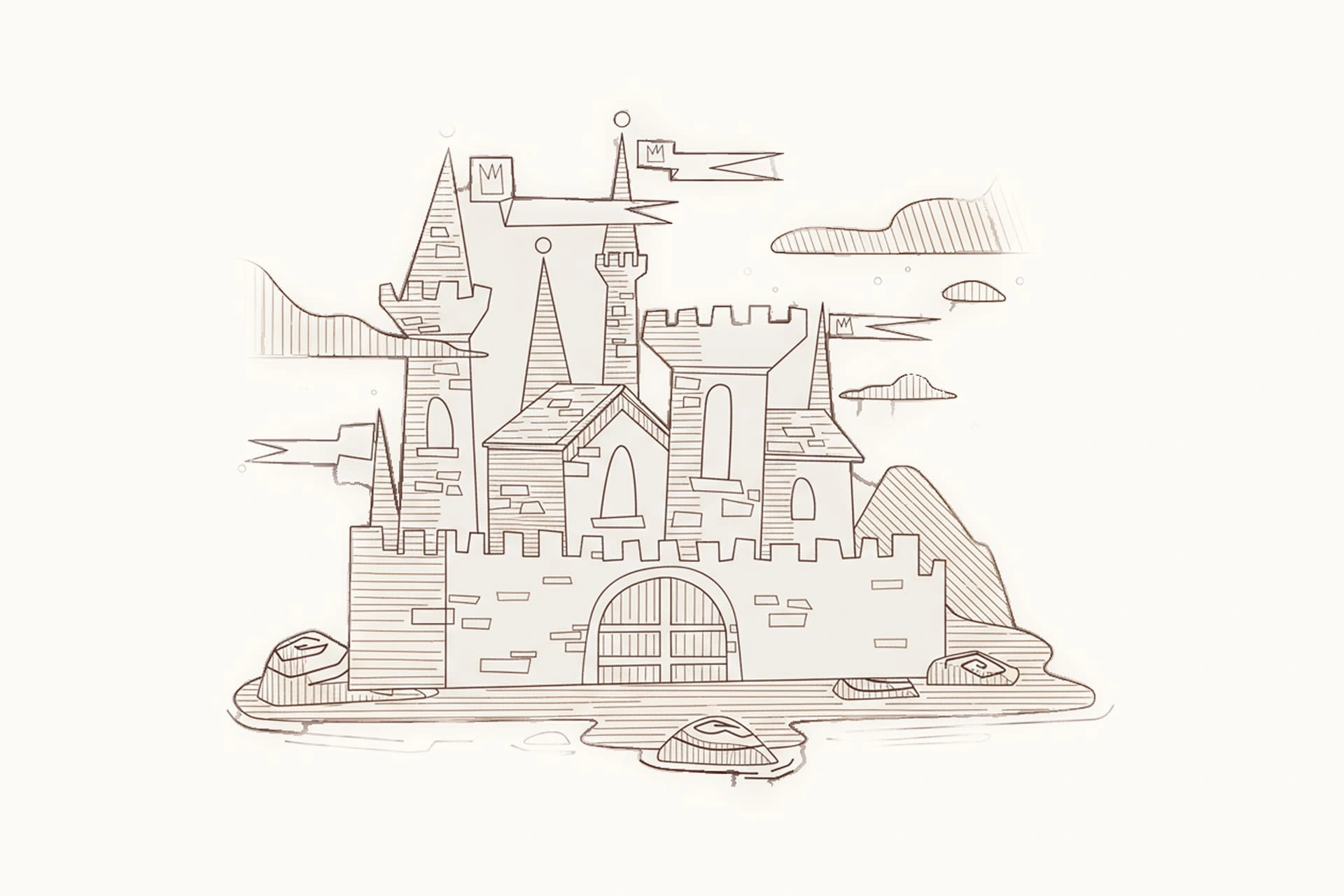
Think of a great company like a rock-solid castle filled with all the gold it’s collected over the years (its profits). Outside those walls, you’ve got endless competitors acting like greedy dragons or enemy troops, doing everything they can to break in and steal that wealth.
So, what keeps that castle standing? What keeps it strong for a hundred years or more? It isn't just higher walls or braver soldiers. It’s a "moat," a deep and wide one that might even be filled with crocodiles.
In the noisy world of investing, we get hit with "hot tips" and "new trends" every single day. It feels like being stuck on a chaotic battlefield, which can be pretty stressful.
Here’s the deal: the key to winning at long-term investing isn't about predicting the outcome of the next little skirmish. It’s about learning how to identify which castles have the most reliable moats.
Investment moats help you sleep soundly at night
There is a reason why Warren Buffett’s moat theory is such a classic. It points out a harsh reality in business: any company making good money will eventually attract a swarm of competitors looking to take a piece of it. That castle and dragon analogy I mentioned earlier isn't just a metaphor. Without a solid line of defense, even the most successful business today will eventually see its profits eaten away.
Thinking in terms of moats helps us ask one vital question: Is this company’s profit built on a lucky one-time win, or is it based on a structural advantage that can actually last for decades?
A company with a wide moat can handle an economic downturn, raise prices without losing its customers, and keep reinvesting its profits to make that moat even wider and deeper. This is exactly why Buffett says he looks for businesses that "even a fool could run." It is because the real protection comes from the business's structure itself, not just from having some genius manager at the helm.
Once you understand this, you won’t have to stress out over every little market swing. You won't feel the need to chase the latest hot stocks, listen to random tips, or try to guess the market's next move. Your confidence will come from the rock-solid competitive advantage of the business you own.
5 main types of moats
Moats come in different flavors, and they usually follow clear patterns that make them tough to beat. We can break them down into five main categories.
Intangible assets
"Just like no one can copy Coke’s secret recipe or brand magic."
This is probably the most obvious type of moat. It involves the things you can’t exactly touch but are worth a fortune.
- Brand: Think about sneakers. Plenty of people are happy to pay a premium for Nike. Or think about soda that red Coca-Cola logo just has an attraction that’s hard to put into words. That kind of brand recognition is a wall that money can’t buy, and it allows companies to charge higher prices.
- Patents: If a company develops tech that the market actually needs (especially in biotech or pharma), patent protection gives them a legal monopoly for a while. This lets them rake in huge profits. Just remember that patents have an expiration date. Once they’re gone, the moat can dry up.
High switching costs
"Once you’re used to the iOS ecosystem, it’s hard to jump ship to Android."
This happens when the cost of moving to a competitor (in terms of money, time, or effort) is so high that customers would rather just stay put. That’s a switching cost.
Think about your iPhone. You’ve got all your photos stored there, you know the interface by heart, and it works perfectly with your Mac or Apple Watch. Moving to Android would be a total headache just thinking about transferring data and relearning everything. Office software works the same way. When a team is used to a specific system and has all their data stored there, switching to something new costs a massive amount of time and energy.
Network effect
"The more people use platforms like Facebook or WhatsApp, the harder it is to leave."
A network effect happens when a product or service becomes more valuable simply because more people are using it.
Social media is the classic example. If all your friends and family are on one app, you’re not going anywhere, even if a new app pops up. The same goes for Visa and Mastercard. Since almost every store accepts them and has the right card readers, it’s nearly impossible for a new credit card company to break that barrier.
Cost advantage
"Can you really produce stuff cheaper than Walmart or Costco?"
If a company can make and sell goods for less than any of its competitors, it can easily win a price war if it feels threatened. Even if there isn't a war, they just make higher profits. This advantage usually comes from being massive.
Take Walmart, for example. Because they buy in such huge volumes, they can negotiate prices that no one else can touch. They then pass those savings on to the customer, which is how they keep their "everyday low price" promise.
Investment moats through regulation
"It’s pretty much impossible for a new competitor to take on BNSF Railway."
The strongest moat a company can have is being "hand-picked" by the government. Essentially, the government uses laws, licenses, or exclusive contracts to give one company the right to run a specific market, keeping everyone else out.
This moat is rock-solid because competitors aren't just fighting a business; they’re fighting a legal wall. Without government permission, you can't just go and build a new railroad system right next to BNSF. You see this a lot in utilities (like power companies), transportation, or businesses that need specific licenses like casinos or waste management.
How to use financial metrics to measure the width of a moat
So far, all this talk about moats sounds like a great business story. But a moat isn't just a concept or a tale; it leaves behind actual proof in the financial reports. We need to learn how to read that proof and verify a company's moat for ourselves.
Metric 1: high gross and net margins
A company with real pricing power doesn't have to slash prices just to survive. Because of their brand, tech, or uniqueness, customers are willing to pay more. You’ll see this directly in their gross and net margins, which stay consistently higher than the competition over the long run.
Metric 2: high ROE
This is one of Warren Buffett’s absolute favorite metrics. Return on Equity basically asks: "For every dollar shareholders put in, how much is the company actually making back?"
Companies without a moat have to constantly dump massive amounts of cash into new factories and equipment just to keep up. But a great business with a moat is like a highly efficient cash machine that generates high returns without needing a ton of new capital. In the real world, if a company can keep its ROE above 15% for a long time, there’s a good chance it has a solid moat. I wouldn't call it "legendary" yet, since several companies might hit that 15% mark, but it’s definitely a strong start.
Metric 3: stable free cash flow
At the end of the day, Economic returns depend on how much cash a company can generate over the next few decades. A company that consistently produces strong free cash flow proves its moat is creating real wealth for its shareholders.
Mastering the moat
We started with an imaginary castle, learned how to spot five types of solid moats, and now we know how to measure them using real numbers.
Success in investing isn't about guessing where the stock price will go tomorrow. It’s about buying a great business with a wide, lasting moat at a fair price, and then just sitting back and letting time do its thing. Forget the stress of chasing every market trend. Treat every Economic like you’re becoming a long-term partner in a great business, rather than just placing a bet where the odds are a mystery.